Home is at the heart of L’Arche Calgary. For more than 52 years, we have shared life together. That long history has given our community deep roots and relationships that stretch across decades. Our houses hold those stories just as much as we do.
Today, our community includes five homes where Core Members and Assistants live: Annapurna, Villa Maria, Kichiyak, Marymount, and Haeremai. However, there has also been a sixth house, one that has not always been in the spotlight. Most recently, it has provided accommodation for Assistants and guests.
Now, as we prepare to rebuild three of our oldest houses into accessible, safe, welcoming homes, this sixth house will be demolished. In its place, our first newly rebuilt home will rise.
But before we say goodbye, it’s worth asking: what story does this house tell?
The answer is layered. It is a story of many identities, many faces, and enough memories to fill an ocean.
410/412: A Beginning
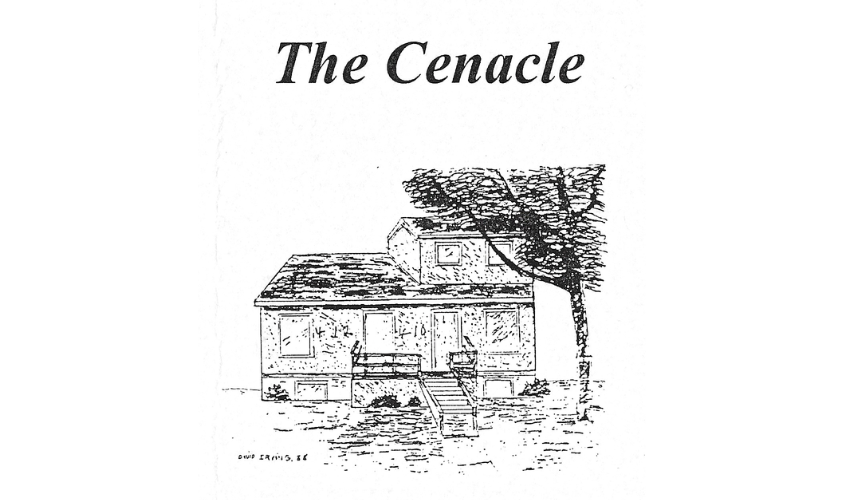
The Cenacle was not always called by that name. When it was built in 1982, it was simply known as 410/412.
Located at 410 53rd Avenue SW, the house was first imagined as a place where L’Arche Calgary’s founding family, the Lenon’s, could have a home of their own while still living alongside the community they helped build.
Construction began during a time of growth. An early community document recalls:
“Since late ’79 the community had been growing internally. People were assuming more responsibility; the Lenon family began to live more separately as a family; and the community was being carried more and more by the group. As a sign of this growth construction began on a new home in early April (1982).”
The board had limited resources, but they believed in the vision. Jo Lenon later reflected: “The vision was to have a home for our family and a L’Arche home next door without a door between.”
Two carpenters, Ron Powers and Nathan Ball, were hired for wages at minimal cost. Friends and community members volunteered their time.
Former Assistant, board member, and long-time community member Dick Bergman remembers how communal the build was: “On Saturdays, they used to invite whoever wanted to come volunteer and help out. Whether it was installing drywall or whatever they needed, whoever showed up could help.”
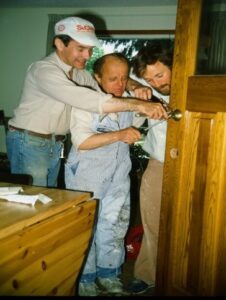
Even Core Member John Hambrook pitched in.
“They had a ramp so they could walk up this little floor to build the walls, and John, he’d walk up this little narrow ramp and cross the gap between the ground and the floor no problem. He’d be in there checking on what Ron and Nathan were doing and if they were keeping up the work,” Dick remembers.
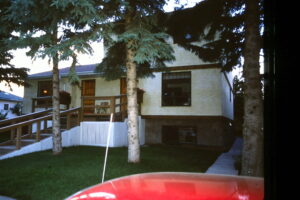
In July 1982, the Lenon’s moved into 410, and Assistant Sue Hall and Core Member Wilma moved into 412. 412 became a small L’Arche household, intentionally designed for two Core Members and two Assistants. About eighteen people lived there over the next decade.
The size of 412 presented some challenges. The two-and-two structure created dynamics that could sometimes be difficult to navigate. While the home holds many fond memories, the community did not repeat this model. Today, our homes are structured with a four-and-four ratio.
Dovie moved into 412 in November 1989, and Dick followed in August 1990. Looking back, Dick remembers his time at 412 as peaceful.
“The moments we had when things were quiet and peaceful, not that it was all quiet, but to be able to make supper and sit and have a glass of wine. Sometimes in some of the households there was lots of stress, 412 had their share of that, but certainly near the end it was a very peaceful.”
In 1992, Dick and Dovie were among the last to leave 412 as the building entered its first major transition.
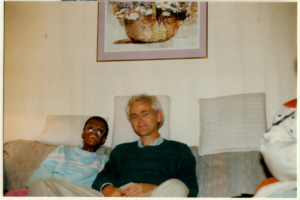
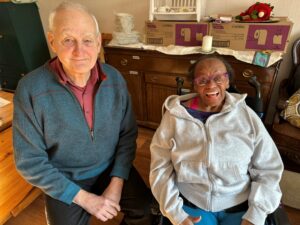
The structure and size of 412 meant it could no longer function effectively as a community home. As the community continued to grow, Kichiyak was conceived, not as a replacement for 412, but as an entirely new vision for a home.
The Lenon’s remained in 410, and Pat Lenon was asked to build a leadership development program for L’Arche in North America. 412 was given as the space to hold the program and used to welcome guests.
In 1996, Pat was called to serve as Community Leader in Lethbridge, so after 14 years, the Lenon’s said goodbye to 410.
Jo remembers it fondly: “It was a wonderful home for our family as our daughter’s lived their teenage and early adult years there. Of course, Pat developed the garden, his specialty and his office was part of the back building along with a Prayer Room available for all in the Community. “
For the first time since 1982, the house had no residents.
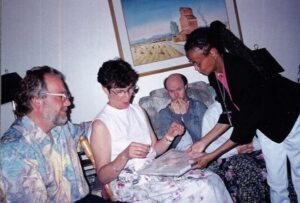
The Cenacle
At that moment, then-Community Leader Pat Favaro began asking a new question: how could the space best serve the community now?
“That’s when we had a big process to decide to start a spiritual centre,” Pat recalls.
Other L’Arche communities had opened spiritual centres, such as L’Arche Daybreak, who still operates theirs to this day. At the time, spiritual life and prayer were a strong priority in Calgary.
The community launched a fundraising campaign and created a proposal in 1996 that described a place that would:
- Find spiritual nourishment to help live the community mission.
- Provide nourishment for assistants to help them discover their part in the mission.
- Define responsibility toward members and provide care and support for all members.
The backyard building was transformed into a chapel. 410 and 412 were newly united as spaces for reflection both individually and in groups.
The centre was named “Cenacle,” after the upper room where Jesus gathered his friends before sending them out on mission.
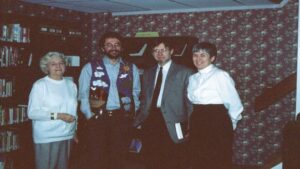
A welcome booklet explained: “Like the Cenacle of Jesus’ time, we hope to find rest and peace in this place so that we can live his mission in our lives.”
For about eight years, the Cenacle lived into that vision.
Pat says. “We had daily prayer in the chapel. The house was a quiet place for reflection.”
It was not established to be a retreat house. Pat says: “It was about being nourished in the mission and the charism so that we could go out and live it in our households and beyond the community.”
By the mid-2010s, the Cenacle shifted again. As the community expanded and changed, the building gradually became more of a social space and home for Assistants. Though its expression evolved, the building continued to reflect L’Arche’s fundamental purpose of building community and impacting society.
A major renovation to Cenacle’s front yard was made with that purpose in mind. An elevator needed to be installed, and an architect and friend of the community suggested a new vision for the space.
“He suggested that we have a space that opened up to the neighborhood to build community.” Pat explains. “That’s why it’s built the way it is, the space in front of the deck where there are benches. We chose to connect to the mission by being open to society and impacting society.”
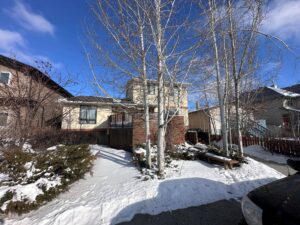
Over the past two decades, the Cenacle has housed countless Assistants and guests. It has hosted celebrations, water fights, shared meals, deep conversations, and personal growth.
The End of an Era and the Beginning of Another
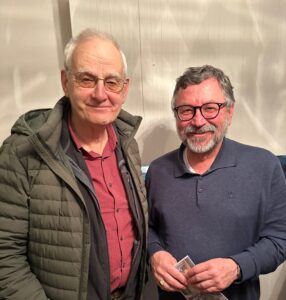
Both Dick and Pat speak about the upcoming demolition with gratitude and hope. The many transitions of this building mirror the evolving needs of the community itself.
“It accommodated a lot of the needs in the community,” Dick reflects. “It contributed to building community. It’s provided that to us since 1992, so for the last 35 years.”
Now, accessibility is at the centre of our vision. Once again, changing needs are leading to change.
“Not everybody can do what they could do yesterday,” Dick says. “You get a little older, and the next thing you know, you need to use a cane. The new homes, they’re to meet people’s needs today.”
We honour the Lenon’s courage, the volunteers who raised its walls, the prayers whispered in its chapel, the laughter shared around its tables, and the many lives shaped within its rooms.
The Cenacle has been a home, a household, a retreat space, a spiritual centre, and a place of welcome.
Soon, it will make way for something new, and just as it always has, our community will continue to grow, respond, and build together.